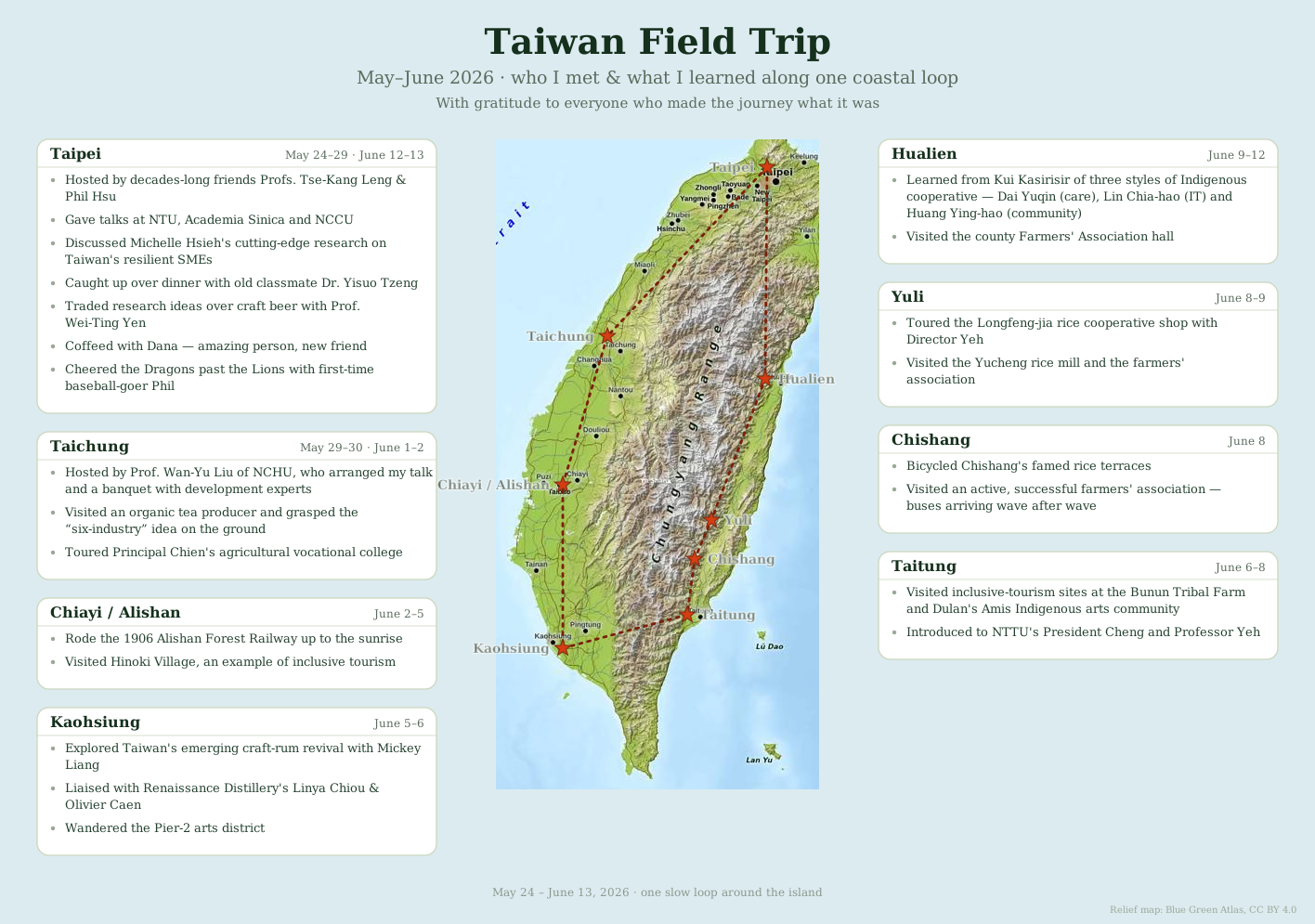
← Trip · May 24 – June 13, 2026
Taiwan — Research Sabbatical 2026
Taiwan was the centrepiece of the 2026 sabbatical — three weeks of talks, long conversations, and a slow loop down the west coast and up the east by train. What follows is the journey as it happened: the people who hosted and humbled me, the places that taught me something, and a few that surprised me.
Taipei — the academic week
May 24–29, and again June 12–13
Two decades-long friends made the week — Professors Tse-Kang Leng (Academia Sinica / NCCU) and Phil Hsu (NTU), who folded me into their wider circle of colleagues, students, friends and family. I gave three talks across the city:
- NCCU — "China's Rise: Four Scenarios in Search of Evidence," with Tse-Kang's graduate students at Chung Chi College
- NTU — "Sufficiency for All: Small-Scale, Low-Tech, Pro-Poor Initiatives," with Phil Hsu
- Academia Sinica (IPSAS) — "The Allure of Modernization: Guizhou's Shift from Inclusive Development to Indebted Growth"
Between sessions, the conversations that stay with me: a long talk with Dr Michelle Hsieh (Academia Sinica) about her cutting-edge work on the resilience of Taiwan's SMEs — the manufacturing base that economists said globalisation would hollow out, and didn't — and where our research might join up. Beer and research ideas with Professor Yen Wei-Ting, a political economist working on informality and insecurity. Dinner with an old classmate, Dr Yisuo Tzeng, picking up midsentence after years. And coffee with Dana — an unplanned hour that turned an acquaintance into a friend.
The lightest moment: cheering the Dragons past the Lions at the ballpark, with first-time baseball-goer Phil at my side.
Taichung — rural development, up close
May 29–30, and June 1–2
My host was Professor Wan-Yu Liu of NCHU, who arranged a talk and a banquet that put me across the table from a roomful of Taiwan's rural-development experts. The day ranged from a tea-garden visit to student presentations to dinner — one of the sabbatical's high points, and the start of a network that opened doors all the way down the east coast.
We visited an organic tea producer where the "six-industry" idea (六級產業化 — growing, processing and selling under one roof, so value stays in the community) stopped being a slide and became something I could walk through. And I spent two hours at Principal Chien's agricultural vocational college (founded 1937, now affiliated with NCHU) — a living case in human-scale workforce development: farm management, forestry, appropriate-technology machinery, a 100-hectare practice forest, and a frank conversation about the slow fade of the co-op programs that once tied schools like his to local industry.
Along the way: coffee at Yourmind Coffee in the South District — one barista, every brewing instrument known to humanity, two cats, a harpsichord upstairs, fifteen minutes to brew and describe a single cup; ice cream and a converted-bank atmosphere at the 4th Credit Cooperative, part of the Miyahara group's adaptive reuse of a 1966 bank building; and an end-of-day IPA at Taihu Brewing while waiting for the train south — Taiwan's craft-beer scene as another register of the small-scale, quality-over-volume argument.
Taitung — inclusive tourism, and the trip's sharpest lesson
June 6–8
The east coast was the research heart of the trip: slower, less developed, more Indigenous, and closest to what Small Steps is about.
At the Bunun Tribal Farm — a Presbyterian-rooted Indigenous cooperative — and in Dulan's Amis arts community, I saw two working models of inclusive tourism. The Bunun farm also handed me the trip's hardest truth, by way of its own staff: others copy the model, but not the spirit, and so they fall short. A recipe travels; conviction doesn't.
The person I keep thinking about is Mr Shi of Libra Ice Cream, who came home to Dulan to make ice cream from his neighbours' fruit — small, rooted, and exactly the point. Professor Liu's network also introduced me to NTTU's President Cheng and Professor Yeh, my door-openers in the south-east. I also walked Beinan Cultural Park, the late-Neolithic site on the way.
Hualien — dignity, cooperatives, and a gorge that stayed shut
June 9–12
Hualien deepened the Indigenous thread. From Kui Kasirisir I learned to hear poverty as a question of dignity rather than money, and through him, three styles of Indigenous cooperative — Dai Yuqin's care co-op, Lin Chia-hao's IT co-op, and Huang Ying-hao's community work — each meeting needs that formal state programs reach past. At the county Farmers' Association hall, a staff member offered a candid theory for Hualien's thinner agri-tourism: earthquakes and typhoons have left tourists wary. (I'm not sure I buy it — Chishang sits under the same skies and thrives — but it was an honest answer, and the difference may be organisation more than weather.)
I'd planned a full day in Taroko Gorge. The rain had other ideas, and much of the gorge remains closed for landslide repair after recent quakes — a reminder that the east coast lives close to the geology. It waits for a return.
I also continued my rum fieldwork at Rumway, an inventive Hualien rum bar — and found, in how it talks about local versus imported spirits, a glimpse of the demand-side puzzle I'll come back to.