This began as two sections of a chapter on China’s central-local relations. The editors wanted the rest of the paper, not these — so here they are, rebuilt for anyone who wants the machinery before the arguments start.
Meet Mayor Zhang.
You know one thing about him — his title — and his title tells you almost nothing.
Zhang might preside over a rural township of fifteen thousand. He might run a metropolis of tens of millions. The word on his card, 市 (shì, “municipality”), attaches to governments that differ by orders of magnitude — in people, in territory, in budget, in the power to make anyone do anything. Two men can both be “Mayor Zhang” and sit four rungs apart on the same ladder.
And once you’ve finally placed Zhang on that ladder, you still haven’t found the person in charge. The mayor runs the government. The Party Secretary outranks the mayor. The top job doesn’t carry the title you were looking for.
One word, four possible ranks, the wrong office at the summit. Now multiply that across five formal levels of government and some forty thousand townships. You begin to see why China’s local state defeats the people who study it for a living. (I’ve spent years in Guizhou trying, and I still get it wrong.)
The frustration is real. It is not random. China’s local government is hard to read because it is the residue of an old problem nobody has ever solved — only re-solved, over and over, each fix leaving a layer behind.
What problem is all this confusion solving?
The problem is as old as large states, and it has exactly two bad answers.
Concentrate power at the center, and you can hold a vast, dizzyingly diverse country together — but Beijing cannot know what a county in Guizhou needs on a given Tuesday. Devolve power to the localities, and you buy flexibility, local knowledge, foresight — but you also get local governments that are hard to watch, easy to corrupt, and quite capable of feeding the very centrifugal forces the center feared in the first place.
There is no clean choice. China worked that out centuries ago. Every arrangement of central and local power trades one danger for another — and which danger a ruler decides to run matters enormously, because it settles not only who governs but who benefits: which interests get privileged, which get sidelined, which communities reach the state’s resources and which never do.
So China keeps adjusting the dial. Under Mao, it pointed hard at the center; discretion was thin and dissent thinner. Under Deng, Jiang and Hu, it swung the other way, into a permanent tug-of-war — province against center, prefecture against province, counties and townships shoved around by forces above them. That churn fueled innovation, hustle and growth. It also fueled corruption. Most China-watchers bet the churn was permanent — that power would stay diffuse, fragmented, plural, and that no single figure would ever again hold near-total control.
Then Xi Jinping.
Why won’t the map hold still?
Here is the deeper reason the system resists understanding. The map keeps changing — and it changes in three different ways at once.
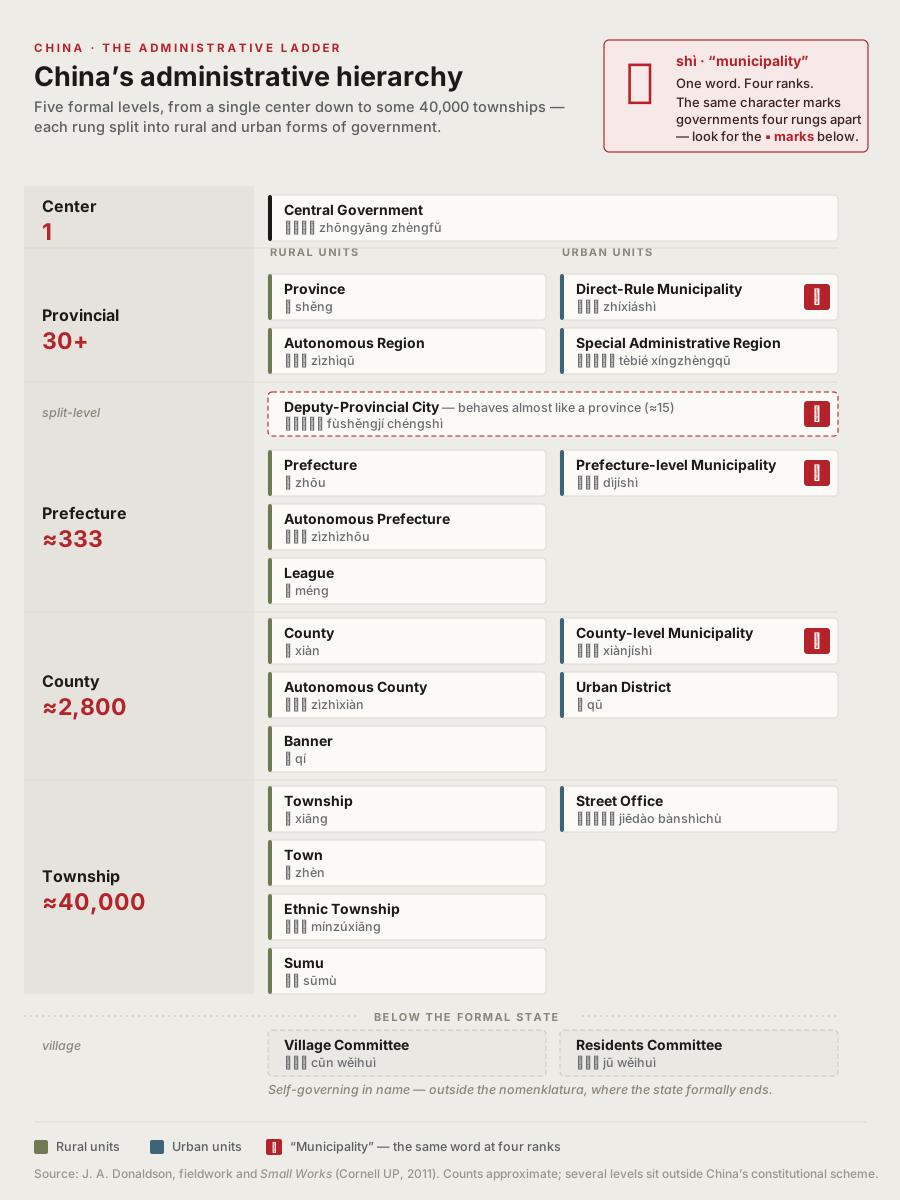
It changes when new levels appear, usually off the constitutional books. After 1949 the young republic slotted six giant “Great Administrative Regions” between center and province, then dissolved them a few years later. Later came the “deputy-provincial city,” a half-rank that let a handful of rich municipalities behave almost like provinces. Under Xi came regional clusters stitched across provincial lines — Jing-Jin-Ji, yoking Beijing, Tianjin and Hebei — and bespoke new zones like Xiong’an, or Gui’an, a single development area that sprawls across two prefectures and five counties. None of these fit the neat five-level chart. All of them, in the end, hand more leverage to the center.
It changes when the types mutate under fixed names. Prefectures began as the provinces’ “dispatch offices,” staffed by provincial agents; they grew into serious powers, and their names climbed to match. “County” now means three different kinds of place. “Municipality,” as we’ve seen, means four. The label stays put while the thing underneath it moves.
And it changes when the rules rewrite themselves. Reform-era China rewrote them three times: first devolving authority to provinces and big cities that became the engines of the boom; then, in the Hu Jintao years, clawing selectively back and letting poor counties report straight past their grasping prefectures to the province; then, under Xi, recentralizing political authority while pushing urbanization hard — a combination whose consequences we are still learning to read.
So what should we actually be asking?
Scholars argue over how far Xi’s recentralization actually went — sweeping, selective, or something subtler still. Set the tallying aside for a moment. Counting how much power flowed back to Beijing turns out to be the smaller question. The sharper one is what that flow did to the places left holding the bag.
Because recentralization under Xi does not so much abolish local agency as redirect and retool it — aiming township energy back toward central ends. A township can be busy, entrepreneurial, hungry for growth and thoroughly harnessed, all at once. So ask not how much discretion Xi pulled upward, but what kind of local action his system now permits and rewards — and what that does to whoever lives at the bottom of the ladder.
Which is where the frustration finally pays off. China’s local government confuses us because the confusion is load-bearing. The blurred titles, the off-book levels, the names that outlive their meanings — these aren’t clutter obscuring the system. They are the system: the accumulated tools a center reaches for when it wants localities energetic enough to deliver growth and pliable enough to control. Read the confusion closely and it stops being noise. It starts telling you who the government is really for.
That’s the thread I chase, on the ground, in one of the places where it matters most — a poor, mountainous, much-adjusted province called Guizhou. (More on that soon.)
These arguments grow out of my fieldwork in Guizhou and Yunnan, first laid out in Small Works: Poverty and Economic Development in Southwestern China (Cornell University Press).