Most people picture the dialectic as progress with extra steps. It isn’t. Progress, as we usually imagine it, accumulates: each generation lays another brick on the wall. The dialectic breaks things: each stage carries a contradiction that tears it apart, and something new emerges from the wreckage.
I argue that this difference explains why the dialectic confuses almost everyone, me included. It also explains why both ideas deserve more suspicion than they usually get.
What do we mean by progress?
The historian J. B. Bury showed that the idea of progress, which feels as natural as gravity, emerged only around the sixteenth century (The Idea of Progress, 1920). Greeks, Romans and medieval Christians held pieces of it. None held the whole package:
- Humanity forms one whole, so gains in one society accumulate to everyone.
- Civilization moves gradually and continually in a desirable direction.
- Knowledge can always advance further.
- Human will, not gods or fate, drives the movement.
- The movement aims at happiness for everyone, an end point that always stays over the horizon.
The ancients saw history as circular, or as a decline from a golden age. Bury’s moderns saw history the way investors see a stock market index: dips and even crashes along the way, but a long climb overall. Nothing fundamental has to break; each gain builds on the last. Bury added a sting, too: no one can prove progress, so believing in it takes an act of faith.
What makes the dialectic different?
The dialectic moves through conflict, not accumulation. It runs in three beats:
- Thesis. An established idea, institution or way of life. It works, for a while.
- Antithesis. The thesis carries a contradiction, and that contradiction produces its opposite. The challenger grows out of the thesis itself; it doesn’t arrive from outside.
- Synthesis. The two collide, and neither survives intact. Something new emerges that keeps part of each while transforming both.
Then comes the step most diagrams miss: the synthesis settles down, becomes the new thesis and develops contradictions of its own. The process repeats.
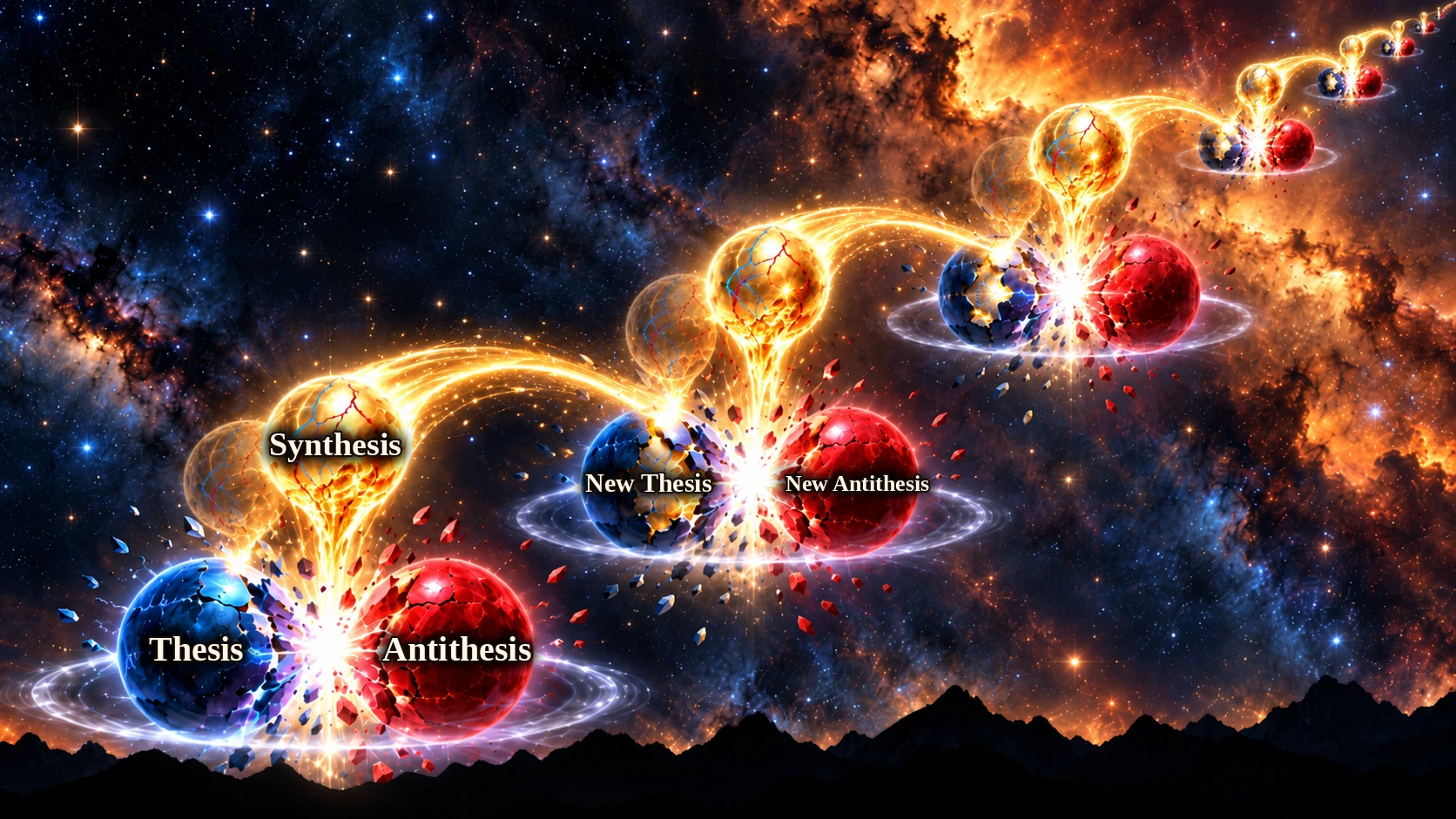
Hegel’s German offers the best one-word summary. Aufheben means both “to cancel” and “to preserve.” A synthesis does both at once, which is why it is neither a compromise nor a victory.
| Progress | Dialectic | |
|---|---|---|
| Shape | A rising market: dips, but up over time | A chain of collisions |
| Engine | Accumulated knowledge and effort | Contradiction and conflict |
| What happens to the old | It stays as a foundation | It is cancelled and preserved |
| How change feels | Gradual, with setbacks | Abrupt, painful, creative |
| Guaranteed? | Its believers assume so | No: a collision can end in wreckage |
What does this look like in real life?
Consider a child learning to read. Letters become words, words become sentences, sentences become books. Each step builds on the last and nothing breaks. That is progress in Bury’s sense.
Now consider the relationship between that child and a parent. It begins as a thesis that works beautifully: total dependence on one side, total authority on the other. Yet the better the parenting, the faster it produces its own contradiction, a child with a mind and will of her own. Adolescence delivers the antithesis. The teenager pushes against the parent; the parent pushes back. Neither can win, because a parent who crushes the will has failed, and so has a parent who simply surrenders.
It really hurts. It is also really amazing. And it creates something that did not exist before.
If the collision goes well, the synthesis is a relationship between two adults. It preserves the love and the shared history of the old relationship while cancelling its hierarchy. Hegel saw this: the family “dissolves,” he wrote, once children grow into free persons who can found families of their own (Philosophy of Right, §177). The new relationship then becomes a thesis with its own contradictions: grandchildren, and one day an aging parent who needs care from the child.
Note what the example does not promise. Nothing guarantees the synthesis. Some collisions end in estrangement, not a higher unity.
Whose dialectic is it?
Part of the confusion comes from the fact that there is no single dialectic. Three thinkers disagree on where it happens and whether it ends.
- Fichte made thesis, antithesis and synthesis an explicit method in the 1790s. For him the process never finishes: every synthesis leaves some opposition behind, so the striving goes on forever.
- Hegel, despite his reputation, rarely used the triad and mocked it as a lifeless formula. He insisted the movement must grow from within the subject matter. His system also closes, in what he called absolute knowing.
- Marx moved the conflict from ideas to material life and social classes. He expected class antagonism to end, closing what he called the “prehistory” of human society.
The image above, with its collisions running off the edge of the frame, is therefore Fichte’s dialectic. Hegel would have called its endless sequence a “false infinity” (schlechte Unendlichkeit; Philosophy of Right, §185).
Thomas Kuhn makes an instructive near-miss. In The Structure of Scientific Revolutions (1962), normal science accumulates, much as Bury’s progress does. Anomalies then pile up inside a paradigm, which sounds dialectical, until a revolution replaces it. Yet Kuhn denied that the new paradigm moves closer to the truth, and he doubted the two could even be compared. His revolutions break without synthesizing. I think that makes Kuhn’s account a story of rupture, not of dialectic.
So what should we do with it?
Bury’s lesson about progress applies to the dialectic too. Both ideas feel like laws of nature, and both are human inventions. Progress assumes that things get better on their own; a popular dialectic assumes that conflict automatically produces something higher. Neither assumption holds. I argue that the dialectic works best as a lens for seeing how change happens, not as a promise about where it leads.
The stakes reach beyond philosophy. Unexamined faith in progress feeds what I call GUTA: Gigantism, Urbanization, Technology-for-technology’s-sake and Accumulation. If progress runs automatically and always upward, then bigger, more urban, more technical and more owned always look like the next step. Treated as a tool rather than a destination, progress, dialectical or not, invites a better question: does this step actually serve people? My own answer is the reverse of GUTA: put sufficiency first.
One puzzle remains. Both ideas grew up in Europe, yet East Asia now believes in progress at least as fervently as the West. Classical Chinese thought had plenty of opposition, from yin and yang to Mencius’s observation that order and chaos take turns. But that opposition cycled; it did not climb. So where did China’s faith in progress come from? That question deserves its own post, once I figure it out.
Sources
- Bury, J. B. 1920. The Idea of Progress: An Inquiry into Its Origin and Growth. London: Macmillan.
- Hegel, G. W. F. 1991 [1821]. Elements of the Philosophy of Right. Edited by Allen W. Wood, translated by H. B. Nisbet. Cambridge: Cambridge University Press, §§177, 185.
- Kuhn, Thomas S. 1962. The Structure of Scientific Revolutions. Chicago: University of Chicago Press.
- Mueller, Gustav E. 1958. “The Hegel Legend of ‘Thesis-Antithesis-Synthesis.’” Journal of the History of Ideas 19 (3): 411–14.